What Is Prepaid Billing? A Guide for API and SaaS Companies
Prepaid billing is back in the spotlight because of how AI APIs charge for tokens. OpenAI sells prepaid credits. AWS sells prepaid Savings Plans. Twilio runs on a prepaid balance. Stripe introduced a Credit Grants API so SaaS companies can issue prepaid balances of their own. If you sell an API or a usage-heavy SaaS product, prepaid is a pricing lever your customers actively ask for.
This guide is the strategic overview: what prepaid billing is, how it differs from postpaid and pure usage-based pricing, the models that work for APIs, and the architecture you need to run it in real time. If you want the Stripe-specific walkthrough, see our companion piece on the step-by-step Stripe prepaid setup guide.
What is prepaid billing?
Prepaid billing is a payment model where a customer pays for a service before they use it. The provider holds the payment as a credit balance, draws down the balance as the customer consumes the service, and prompts a top-up when the balance runs low. It is common in telecom, utilities, cloud platforms, AI APIs, and developer tools.
The key contrast is with postpaid billing, where the provider tracks usage across a billing period and sends an invoice at the end. Prepaid moves the money first and the consumption second. Postpaid does the opposite. Both can be tied to fixed plans, metered usage, or a combination of the two.
For B2B SaaS and API companies, prepaid solves three problems at once: it removes the credit risk of new customers, it gives buyers a hard ceiling on spend, and it lets a vendor charge for high-variance workloads (LLM tokens, video minutes, SMS sends) without being stuck chasing invoices.

Prepaid vs postpaid vs usage-based billing
The three models are often conflated, but they answer different questions. Prepaid answers “when does the customer pay?” Usage-based answers “how is the price calculated?” Postpaid is what most people mean when they say “invoice me later.”
| Dimension | Prepaid | Postpaid | Pure usage-based (PAYG) |
|---|---|---|---|
| When customer pays | Up front | End of billing period | End of billing period |
| Billing trigger | Top-up event | Period close | Period close |
| Revenue recognition | Deferred until consumed | At invoice | At invoice |
| Risk of non-payment | Near zero | Real (collections, write-offs) | Real |
| Customer budget control | Hard cap | Soft cap (alerts only) | Soft cap |
| Best fit | New customers, AI tokens, SMB, no-credit markets | Enterprise contracts, predictable workloads | Mid-market with established credit |
Prepaid and usage-based are not mutually exclusive. OpenAI’s API ties them together: customers buy prepaid credits, then per-token rates burn those credits in real time. AWS does the same with prepaid Savings Plans on top of metered EC2 and Lambda consumption. The combination is often called prepaid usage billing, and it is the model most modern API products land on once they outgrow flat-rate plans.
For a deeper look at the consumption side of the equation, see our overview of usage-based billing for APIs.
How prepaid billing works in real time
A prepaid billing system has three jobs: hold a balance, decrement it accurately as usage happens, and stop the customer (or warn them) before the balance hits zero. The “in real time” part is what separates a working system from one that issues surprise overage bills.
At a minimum, the architecture has four moving pieces:
- Wallet or credit balance. A persistent record of how much prepaid credit each customer or account holds. Stored in the billing provider (Stripe customer balance, Chargebee credit notes) or in a wallet service of your own.
- Usage meter. A real-time pipeline that captures every billable event, an API call, a generated token, a delivered SMS, and attaches it to a customer ID.
- Rating engine. The component that converts raw events into currency. A
/v1/chat/completionscall might cost 0.000015 USD per input token; the rating engine applies the price and returns a debit amount. - Quota enforcement. The gate that blocks (or throttles) requests once the balance is exhausted, instead of letting customers run up unpaid usage.
In telecom this stack is called an Online Charging System (OCS). For APIs, the same pattern shows up as an API gateway feeding a metering service, which writes against a wallet held in a billing provider. Stripe documents this pattern in its Credit Grants and Meters APIs. Twilio publishes it in its account balance docs. The names differ; the loop is the same.
The reason real-time matters is settlement risk. If your meter lags by an hour, a runaway script can consume thousands of dollars of credit you cannot reclaim. Real-time metering with sub-second visibility, what API usage metering is built for, closes that gap.
Common prepaid billing models for APIs and SaaS
Most prepaid implementations in API and SaaS land in one of four patterns. The right choice depends on how predictable usage is and how much friction your buyers will tolerate.
Prepaid credits
The customer buys a dollar (or token) balance and consumes it across any product. OpenAI runs this model: customers add credit to their account, then any API call, chat completions, embeddings, audio, burns from the same pool. Anthropic, Cohere, and most AI gateways follow the same pattern. It works well when pricing is per-call or per-token and customers want to test before committing.
Prepaid quota or allowance plans
The customer prepays for a fixed quantity, 1 million API calls, 10,000 SMS sends, 500 GB of bandwidth, usually as part of a monthly plan. Once the quota is exhausted, requests are either blocked or shifted to overage pricing. This is the SaaS equivalent of a prepaid mobile plan: predictable for the buyer, predictable revenue for the seller.
Hybrid prepaid + usage overage
The customer prepays a base allowance, then pays metered overage for anything beyond it. Twilio uses a variant of this on top of its account balance. It captures both the commitment revenue of a subscription and the upside of heavy users. For most API companies trying to expand existing customers, hybrid is the model worth modeling first. We cover the broader strategy in our piece on pricing models for AI APIs.
Prepaid auto-recharge
A variant on the above: when the balance drops below a threshold, the system automatically charges the saved payment method to top it up. OpenAI offers this so customers don’t get throttled mid-workflow when credits run out. Auto-recharge keeps the prepaid budget control while removing the friction of manual top-ups.
When to choose prepaid billing (and when not to)
Prepaid is the right call when one or more of these are true:
- Usage is high-variance or unpredictable. AI inference, video processing, and SMS campaigns can spike 10x in a day. Prepaid caps the customer’s exposure and yours.
- You sell to self-serve or SMB customers. Prepaid removes credit checks, collections, and the operational overhead of invoicing small accounts.
- You operate in markets where postpaid credit is hard. Many developers outside the US and EU cannot easily get a corporate card with sufficient limit. Prepaid via wire, ACH, or local rails sidesteps that.
- Your product is fraud-prone. Prepaid eliminates the “use the API for free, dispute the invoice later” pattern that plagues SMS, calling, and image generation APIs.
- You sell AI tokens or per-event units. The OpenAI/Anthropic/Cohere standard is now prepaid credits. Selling differently makes you the odd one out.
Prepaid is the wrong call when:
- You sell large enterprise contracts. Procurement teams expect NET-30 or NET-60 invoicing, not credit top-ups.
- Usage is highly predictable. A flat subscription is simpler and more revenue-stable.
- Your unit economics depend on annual commitments. Prepaid tends to encourage shorter cycles unless you bundle it with a multi-month commitment discount.
For a broader perspective on packaging decisions, see our guide to API monetization strategy.
How to implement prepaid billing for your API
Building prepaid billing is less about the billing UI and more about the metering loop behind it. Here is the order that usually works.
Real-time usage metering
Start with the meter, because nothing else works without it. Every billable event needs a customer ID, a timestamp, a unit count, and enough metadata to debug pricing disputes later. Capture this at the API gateway or directly in your application code with an SDK. We handle this layer for APIs; Stripe’s Meters API handles the lighter case. See our metered billing introduction for the data model.
Credit balance and wallet management
You need a single source of truth for the balance. The two common options: use your billing provider’s native balance (Stripe customer_balance, Chargebee promotional credits, Zuora prepaid funds) or run a wallet service in your own database that syncs to the provider. The first is simpler. The second gives you sub-second decrement latency and the ability to enforce quotas before the request runs.
Billing-provider integration
Stripe, Zuora, and Chargebee all support prepaid in some form, but the integration surface differs. Stripe’s Credit Grants API treats prepaid as one-time grants tied to a customer; Zuora has dedicated prepayment accounts; Chargebee uses promotional credits. Pick the one your finance team already runs on rather than introducing a second platform. If you are on Stripe, our step-by-step Stripe prepaid setup guide walks through the API calls. The same logic applies to Stripe’s broader usage-based billing setup with Moesif.
Customer notifications and top-up flows
The most common customer complaint about prepaid is “I didn’t know I was about to run out.” Build threshold alerts at 50%, 20%, and 5% of remaining balance. Send them by email, in-product banner, and webhook to whatever the customer is paying you for (so a Slack-bot vendor can warn their own customers). Offer auto-recharge as the default opt-in.
Quota enforcement and governance
Once a customer’s balance hits zero, you have a choice: hard-block requests, throttle to a slow lane, or allow a small negative balance (“grace overage”). Hard-block is safest for fraud-prone APIs. Throttle is friendlier for paying customers. Whatever you pick, enforce it at the gateway, not after billing, or you will end up writing off uncollectable usage.
Reporting and analytics for prepaid plans
A prepaid plan generates three numbers that matter more than the rest: burn rate, top-up cadence, and expiry.
- Burn rate tells you how fast a customer is consuming credit. A burn rate that suddenly doubles is either a power user expanding (good) or a runaway integration (bad, page the customer).
- Top-up cadence tells you whether customers are sticking. Customers who top up monthly on a consistent amount are effectively a subscription. Customers whose top-ups slow down are churning quietly.
- Expiry matters if your credits have an expiry date. Track unexpired liability so finance can recognize revenue correctly, and track credits that almost expired to identify customers who over-bought.
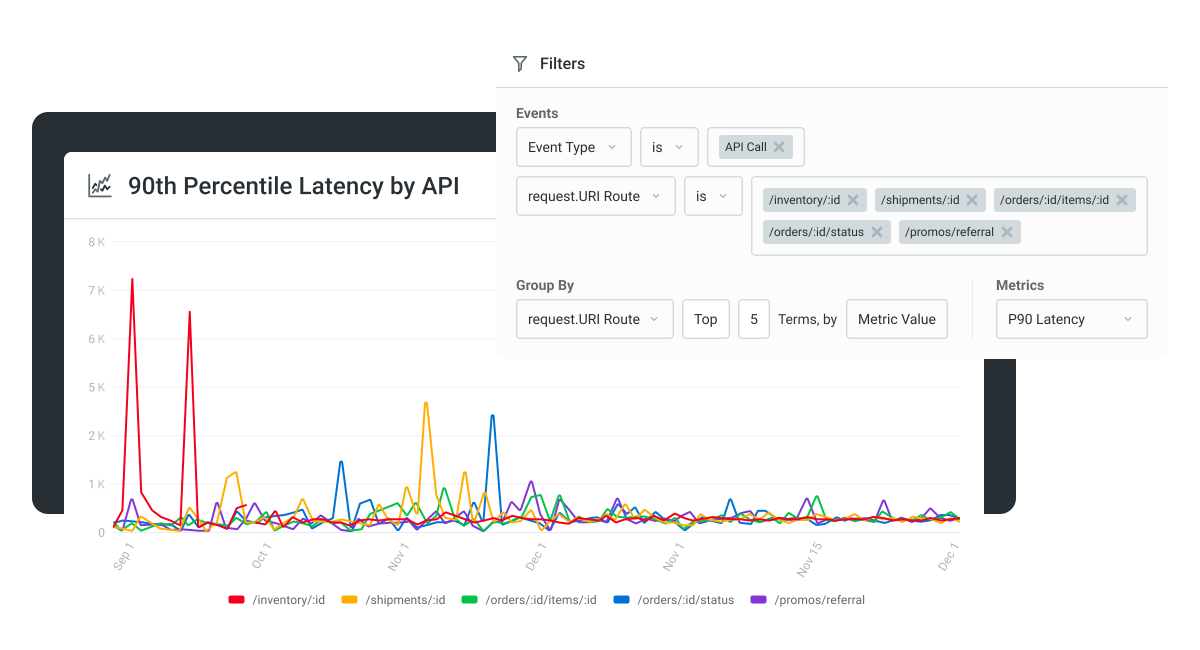
For B2B API products, layer in per-endpoint reporting: which routes burn the most credit, which customers concentrate on which routes, and which routes have the worst margin. The same metering pipeline that drives billing also drives this analysis. It is the same data set we describe in our writeup on building an internal chargeback model.
The “prepaid invoice” your customer receives should make all of this legible: opening balance, top-ups, line-itemized consumption, closing balance. Vague invoices generate support tickets.
Security, compliance, and fraud considerations
Prepaid changes the fraud surface compared to postpaid. The fraudster’s goal shifts from “use the service and dispute the invoice” to “compromise a customer’s account and drain their balance.” A few non-obvious defenses:
- Velocity limits on top-ups. Anomalous top-up patterns (ten 500 USD charges in an hour) usually mean card testing, not a legitimate customer.
- Step-up auth on balance withdrawal. If you let customers withdraw unused balance, treat it like a bank transfer: SCA, email confirmation, hold period.
- Refund policy in writing. Prepaid credits regularly draw chargebacks if buyers expect a refund and you do not have a stated policy. Publish one and reference it on the top-up page.
- Data protection. Wallet balances and consumption logs are personal data under GDPR and CCPA when tied to an identified user. Retention windows, deletion requests, and cross-border transfer rules all apply. Build them in from day one.
- PCI scope. If you store any payment method to enable auto-recharge, do it through your billing provider’s tokenization. Never persist a PAN in your own database.
How Moesif powers real-time prepaid billing for APIs
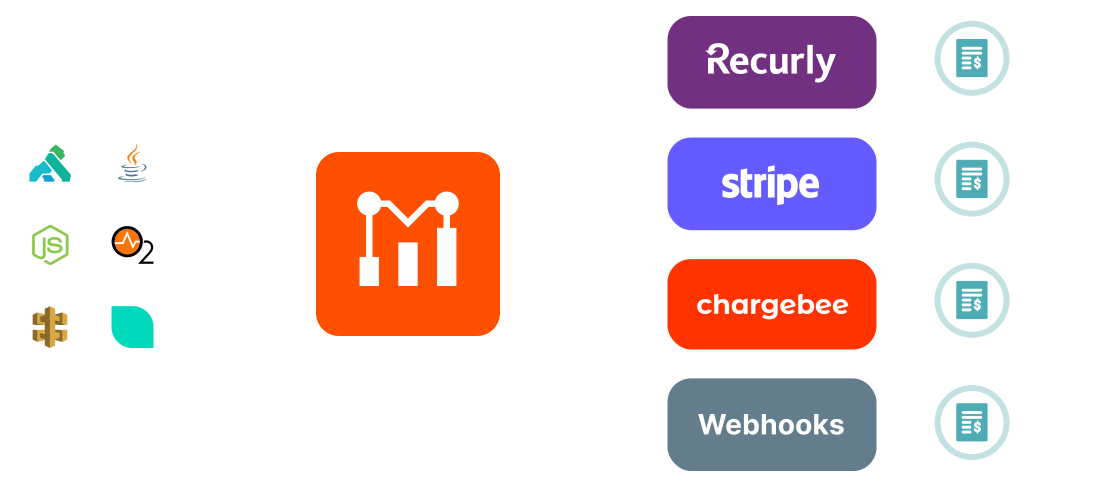
We sit at the metering and governance layer, not the wallet layer. We meter usage, evaluate governance rules, track usage credits where configured, and send usage records to billing providers (Stripe, Recurly, Chargebee, Zuora) or custom systems via webhook. The wallet/invoice ledger remains the customer’s chosen billing provider.
The pieces that matter for prepaid specifically:
- Usage Credit Tracking. Track credit balances per company or user, decrement them against any metered event, and surface the balance through the embedded developer portal. See the Usage Credit Tracking docs for details.
- Quotas and Governance. Enforce hard limits or throttle at the gateway when a customer’s balance is exhausted, so requests stop before they create uncollectable usage.
- Custom Actions. Trigger top-up reminders, account alerts, or auto-recharge calls when balance thresholds are crossed.
- Pre-built integrations. Stripe, Recurly, Chargebee, Zuora, and webhook outputs for in-house billing or AWS Marketplace.
- Embedded API Metrics and developer portal. Show your customers their consumption and remaining balance inside your product, without building the UI from scratch.
We power the metering and governance layer. Your billing provider holds the wallet and issues the invoice. The two together, connected through pre-built integrations, give you a working prepaid system. There is a 14-day free trial with no credit card required.
Frequently asked questions
What is prepaid billing?
Prepaid billing is a payment model where a customer pays for a service before using it. The provider holds the payment as a credit balance, decrements it as the customer consumes the service, and prompts a top-up when the balance runs low.
What is a prepaid billing system?
A prepaid billing system is the software stack that runs prepaid: a wallet to hold the balance, a real-time meter to capture usage, a rating engine to convert events into currency, and a quota enforcer to stop or throttle the customer when the balance hits zero.
What’s the difference between prepaid billing and usage-based billing?
Prepaid describes when the customer pays (up front). Usage-based describes how the price is calculated (per unit of consumption). They are often combined: the customer prepays a credit balance, and per-unit consumption burns it down in real time.
Can I combine prepaid credits with usage overage?
Yes. This hybrid model, prepaid base allowance plus metered overage, is the most common pattern for B2B APIs. The customer commits to a baseline spend, you capture upside from heavy users, and neither side is surprised at invoice time.
How do I set up prepaid billing for my API?
Build the metering pipeline first (every billable event tagged with a customer ID), then choose where the wallet lives (your billing provider or your own database), then connect the two so usage decrements the balance and top-ups credit it. The step-by-step Stripe prepaid setup guide covers the Stripe-specific implementation.
What are the disadvantages of prepaid billing?
The main downsides are higher friction for enterprise buyers (procurement prefers invoices), the need to handle customer-facing balance UI, and the operational overhead of refunds, expiry, and disputed top-ups. For self-serve and AI API businesses, the trade-offs usually still favor prepaid.

Related Articles

API Strategy
Leveraging AI For a Better API Strategy
Learn how to leverage AI to build and fortify your API strategy. Improve design, governance, documentation, and align APIs with business outcomes.
API Strategy
The 5 Best Mixpanel Alternatives of 2025
Learn about the best Mixpanel alternatives to determine the right analytics solution for your use case.

API Development
How to Leverage Moesif Effectively for API Observability
Effectively leverage Moesif for API observability through best practices for integration, event enrichment, custom actions, and engineering workflow integrat...
API Strategy
How to Build an Internal Chargeback Model for Your API and AI Usage Using Moesif
Use Moesif to implement internal chargebacks and enable precise API and AI cost attribution for better transparency and resource optimization.