Leveraging AI For a Better API Strategy
“API strategy” is a term prominently established in the ecosystem and heavily discussed, implemented, and followed by organizations. The term is more relevant now since API strategy has become, for the most part, AI strategy, since AI agents and services are now consuming APIs and tools to work towards business-specific goals under human tutelage. So the longstanding definition and scope of API strategy must take into account AI consumers.
Then comes the actual process of building the API strategy. To no one’s surprise, here we can use AI too. So this article will be about how we can use AI to assemble and put into action better API strategies.
What is API strategy
API strategy thoroughly outlines, in a high-level, how to use application programming interfaces (APIs) to drive meaningful business outcomes. It aligns APIs with revenue, reliability, and long-term growth.
The first obvious benefit of this premeditation is that your API program, since its inception or conceptualization, has zero misalignment with the business requisites, and close to zero chances of such in the future.
Look at modern SaaS or enterprise environments: there exists internal platforms, partner ecosystems, and integrations shouldered by APIs, even more so with organizations’ oftentimes aggressive AI adoption. APIs have therefore become business infrastructure; API strategy guarantees that you intentionally, measurably, and sustainably maintain those interfaces.
An efficacious API strategy answers these questions:
- Why does this API exist? It must support one or more business objectives.
- Who consumes it? The consumer demographic may consist of external developers, partners, internal teams, or monetized customers.
- How does it evolve safely? Versioning, deprecation, and compatibility policies must exist.
- How is it measured? Usage, performance, and revenue signals must inform decisions.
APIs slip into mere technical assets if you fail to answer these questions, since no strategic direction exists. You will ship endpoints, monitor them, but flounder to connect API behavior to business impact. And things deteriorate as you scale.
AI can help build and solidify your API strategy, but it can only do so when teams have established a lucid definition of the strategy itself and a shared understanding of that strategy.
The limits of traditional API strategy
Modern APIs generate millions of requests, across regions, tenants, and use cases. The static style guides, rigid review processes, and manual approval gates will work for a portfolio of ten APIs, but unquestionably break down at enterprise scale. Without the force-multiplying capability of AI, the traditional way of strategizing APIs around your business aims will only cost you capital, by stifling innovation and introducing risks.
Governance and decisions
Traditionally, maintaining quality requires human intervention. So your architects will look at documents and resources like OpenAPI specs for consistency, security, and standards. However, as the number of APIs and their integrations grow, review teams get overwhelmed. It also becomes more impractical to not have automated processes in place that are principled and controlled. You will be waiting weeks for approval or the situation will likely force your hand to sidestep governance entirely, precipitating shadow APIs, which are even more precarious now in the AI-saturated market.
And with growth, strategic decisions also get harder. For example:
- Pricing tiers set without deep behavioral segmentation
- Security policies applied uniformly across different risk profiles
- Roadmap priorities based on anecdotal customer feedback
These decisions often rely on partial signals, but not the entirety of the context. When in small scale, you can intuitively make that deficiency work, but not in large scale.
Specifications
AI-assisted software development means code changes even faster now than documentation. So how feasible is the static strategy that relies on that documentation being the source of truth?
If you don’t have automated, intelligent feedback loops, the discrepancies between the designed API (the spec) and the running API (production) only exacerbates.
Forward-looking analytics
What insights does your API analytics give you?
- Request volume against an endpoint
- Average latency
- Tenants generating the most traffic
These are, undoubtedly, valuable. But they don’t explain why behavior changed nor predict. You might suddenly discover that usage has dropped for a major customer; you have the dashboards to verify that. But what is the churn risk? An endpoint might have low volume but high strategic dependency, like having many high-value accounts depend on it. You need AI-powered analytics tools like Moesif to keep tabs on such scenarios.
Scale changes the problem
Throughout the expansion of the API ecosystem, more customers integrate, more partners build on top, and more internal services depend on shared contracts. But every new integration also contributes to the complexity.
Human-driven analysis doesn’t scale linearly with complexity; the surface area grows faster than the team’s amplitude. As a result, you inevitably face problems like this:
- Slower incident response
- Missed monetization opportunities
- Reactive roadmap adjustments
Modern, AI-powered API ecosystems will exceed the assumption that you can interpret all relevant signals by yourself for a perceptive, cogent API strategy. You need to incorporate AI to keep in pace with the scale of modern software systems and the competitive innovation in building such systems.
Where AI improves API strategy
AI improves API strategy at two moments: when you first define it and as you review, manage, and update it over time. In both cases, AI can help ground strategic conversations in observable patterns as opposed to assumptions.
API design and governance
Decisions behind API standards, versioning rules, and design conventions often rely on documentation and review processes that vary across teams. For example, producers focus on delivery, governance focuses on policies, and product concentrates on time-to-market.
By integrating AI, you can review OpenAPI contracts at scale, detect schema inconsistencies, identify and escalate potential breaking changes, and highlight divergence from naming or structural standards. You will know about compatibility risks before release.
Being able to evaluate measurable drift is better than debating whether or not standards are being followed, and friction between producers and governance roles.
Development confidence and flexible strategy
Your confidence in any strategic change results from delivery confidence. Teams, for good reasons, will hesitate to evolve APIs if the test coverage and protocols is weak or contract validation is inconsistent.
AI can help generate tests, discover edge cases, and validate contracts, all of which contribute to increased confidence in iterative development. You can simulate scenarios and verify compatibility faster.
For API-early teams, this creates a disciplined foundation. And API-first organizations can more quickly adapt their strategy to business requisites.
Documentation and developer experience
One of the most common strategy gaps appears in adoption. APIs are technically sound but can be difficult to understand or integrate. AI can generate documentation drafts from contracts, summarize version changes, and analyze support tickets to identify recurring motifs that thwart customers from achieving their goals. Later on, they are automatically added to the documentation to help troubleshoot future issues.
AI can also help generate SDKs and their documentation, examples, onboarding flows, guides, and tutorials, as well as keep them updated. Changes in each release and their impact internally and on customers, technical and business, can be efficiently and apropos communicated.
Through an intelligent, automated, and controlled process, documentation and related resources evolve and accommodate the product as well as its customers. The end result is a materially improved and forward-looking developer experience.
Lifecycle decisions
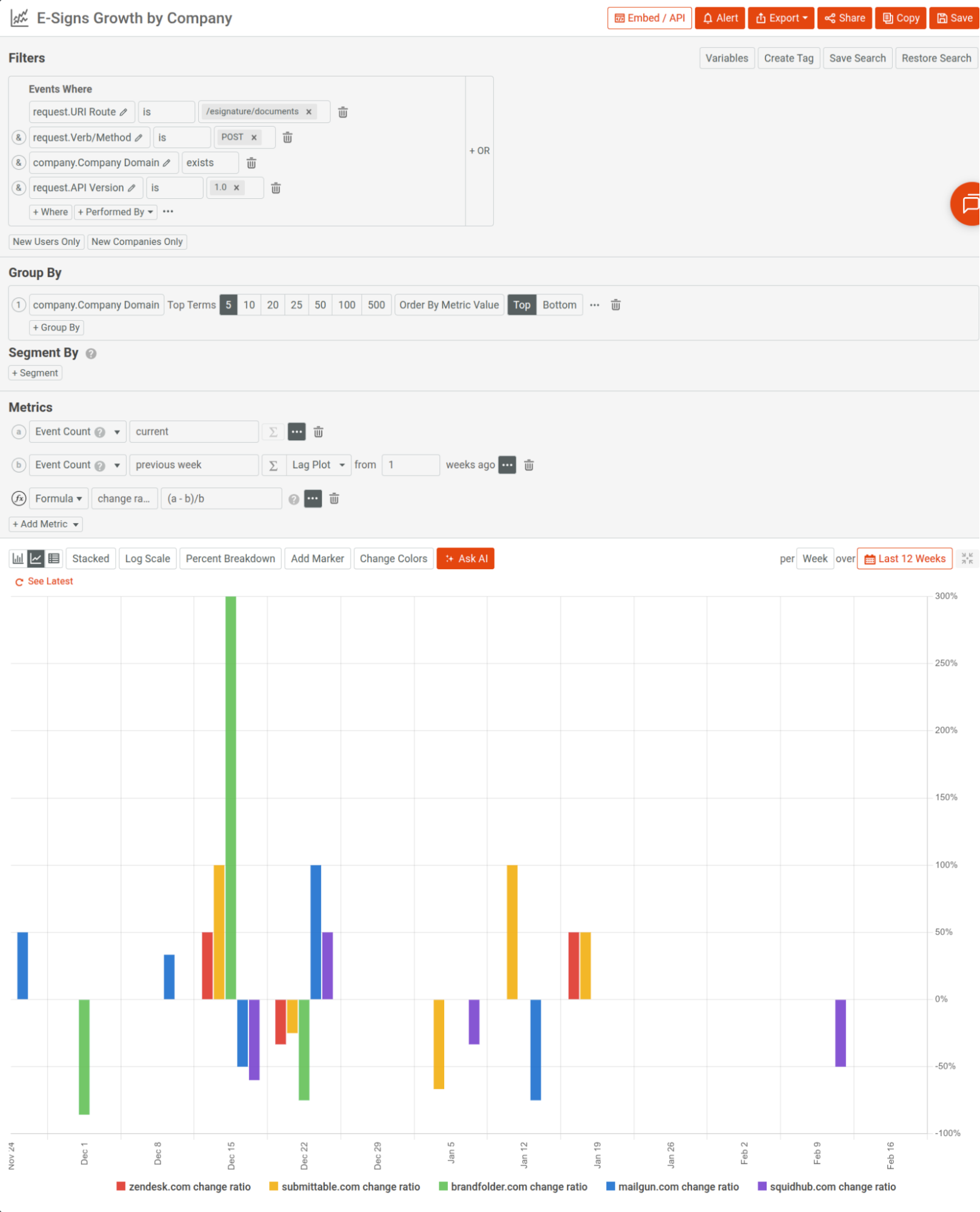
How do you definitively know whether a version is safe to deprecate or whether migration is complete? It is one example of a lifecycle decision that has debates and disagreements around.
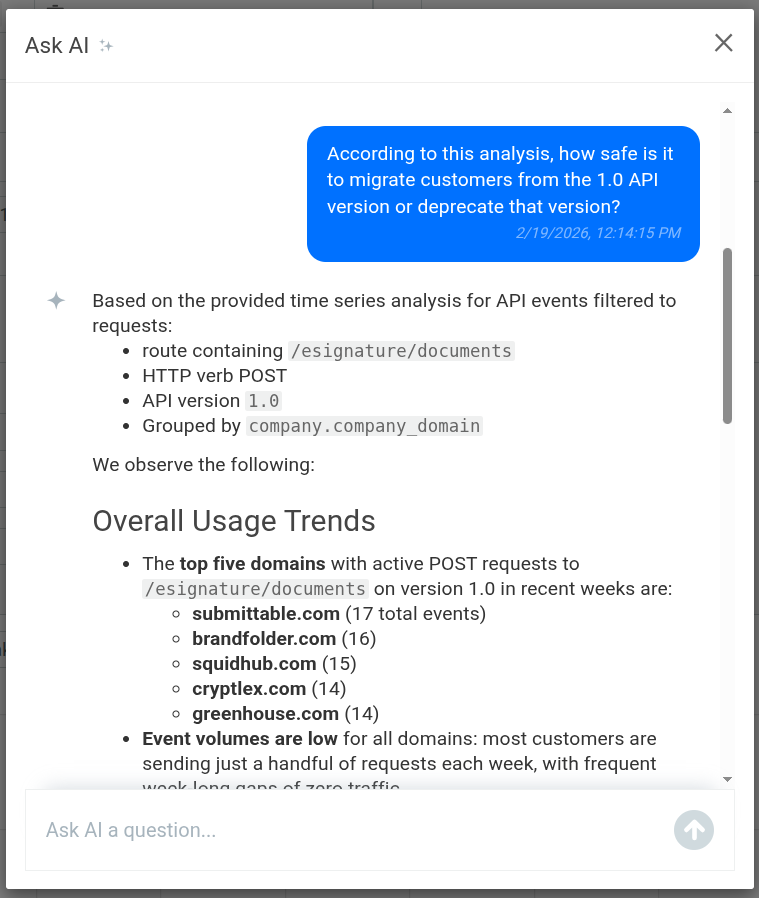
Using AI-powered platforms like Moesif, you can get insights about adoption patterns across accounts and environments. You can identify where migration readiness is strong and where risky. AI helps with lifecycle decisions by making data-backed insights more accessible, thereby making those decisions evidence-driven as opposed to only being a matter of timelines.
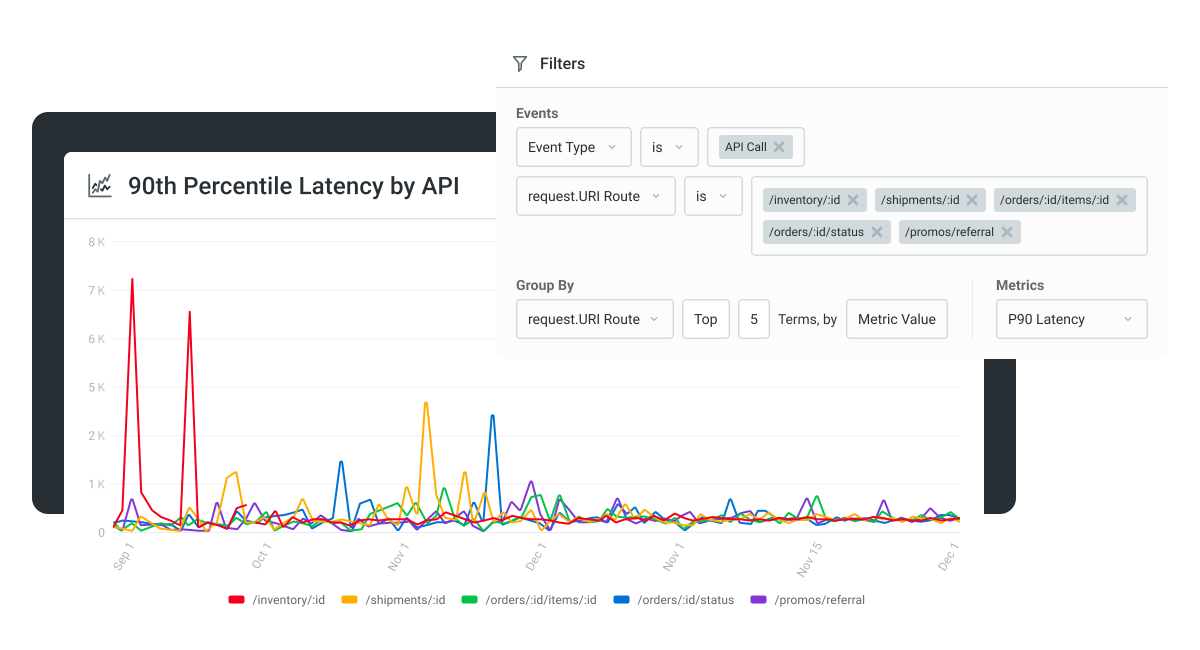
For example, the following time series looks at API adoption for a version across customers:
We can then select Ask AI to quickly get some insights into migration and deprecation posture of the API version:
Aligning API behavior with business outcomes
People have differing incentives. A developer cares about the code, but a product manager cares about adoption. If you don’t understand the incentives of the person you are talking to, empathize with them, you won’t make progress.
AI can help correlate usage with retention signals, expansion behavior, support load, and revenue exposure. You can leverage it to establish a shared analytics layer across roles, irrespective of the varying technical expertise of the individuals. This allows leadership to evaluate aspects that materially influence business outcomes.
Moesif’s AI Explain makes analytics accessible to every team member; they can ask questions about the real-time analytics data to quickly garner insights that they can start acting on in no time.
How to introduce AI into your API strategy
Let’s go back to another one of Kin Lane’s posts that opines that starting with an API strategy must follow a thorough understanding of where one is in their API journey. We can follow that same line of thought when introducing AI in the process.
So if your organization is API-early, before anything else, make sure API contracts are standardized and usage data is structured. You want your current state of affairs as lucid as possible: a very promising aspect where you can leverage AI.
If yours is an API-aware but wrestling with governance alignment, introduce AI at points of disagreement. Governance reviews is another great place to leverage AI, for example dependency management.
For API-first organizations operating at scale, focus on business alignment. Use AI-powered analytics tools like Moesif to correlate API usage with revenue and retention. You can also analyze support cost, and even consider using AI-powered chatbot for real-time support. You can use AI to model your roadmaps and discuss pricing to precisely control the economic impact of your endeavors.
Regardless of maturity in terms of where you are in the API journey, the foundation remains the same: data discipline. You must consistently enrich and tag requests with contextual information like tenant, version, and plan data. Make contracts machine-readable. Same goes for support-related analysis.
It’s also important to introduce AI within the existing cadence of your strategic activities, for example, quarterly roadmap reviews, lifecycle planning sessions, and pricing evaluations. Irrespective of whether or not AI is there, leadership must remain accountable for decisions.
A sound approach is to start with one recurring tension in your API strategy. Then observe the outcome that follows after you make the decision with the help of AI. Based on the result, if you are confident, you can branch out into more.
Conclusion
Introducing AI into API strategy is an incremental enhancement to how you review and refine strategy. The proliferation of AI and its democratization across disciplines are showing us how powerful and critical the roles of APIs are. AI-assisted API strategy offers meaningful benefits there as we build and deliver more complex software through more proactive, automated, accessible, and fast processes in API lifecycles.
 Align API Usage with Business Outcomes using AI
14 day free trial. No credit card required.
Try for Free
Align API Usage with Business Outcomes using AI
14 day free trial. No credit card required.
Try for Free

Related Articles

API Strategy
The 5 Best Mixpanel Alternatives of 2025
Learn about the best Mixpanel alternatives to determine the right analytics solution for your use case.

API Development
How to Leverage Moesif Effectively for API Observability
Effectively leverage Moesif for API observability through best practices for integration, event enrichment, custom actions, and engineering workflow integrat...
API Strategy
How to Build an Internal Chargeback Model for Your API and AI Usage Using Moesif
Use Moesif to implement internal chargebacks and enable precise API and AI cost attribution for better transparency and resource optimization.
API Development
Introducing Moesif Basic Insights for WSO2 API Manager (APIM) and Bijira
Announcing Moesif Basic Insights for WSO2 API Manager and Bijira—a free, integrated, and AI-ready API analytics solution in WSO2.